Let’s talk about a bad bunny.
No… not the one who lit up the Super Bowl stage last February.
I’m talking about the kind of bad bunny that quietly drains your feed bill. It doesn’t give much back to the homestead.
If you’re building a permaculture-based homestead or even a small backyard production system, this is a conversation we need to have honestly — and with a little humor.
Because sometimes the sweetest, fluffiest rabbit on the place…
is actually a bad investment.

Meet Alice: adorable, sweet… and a bad bunny
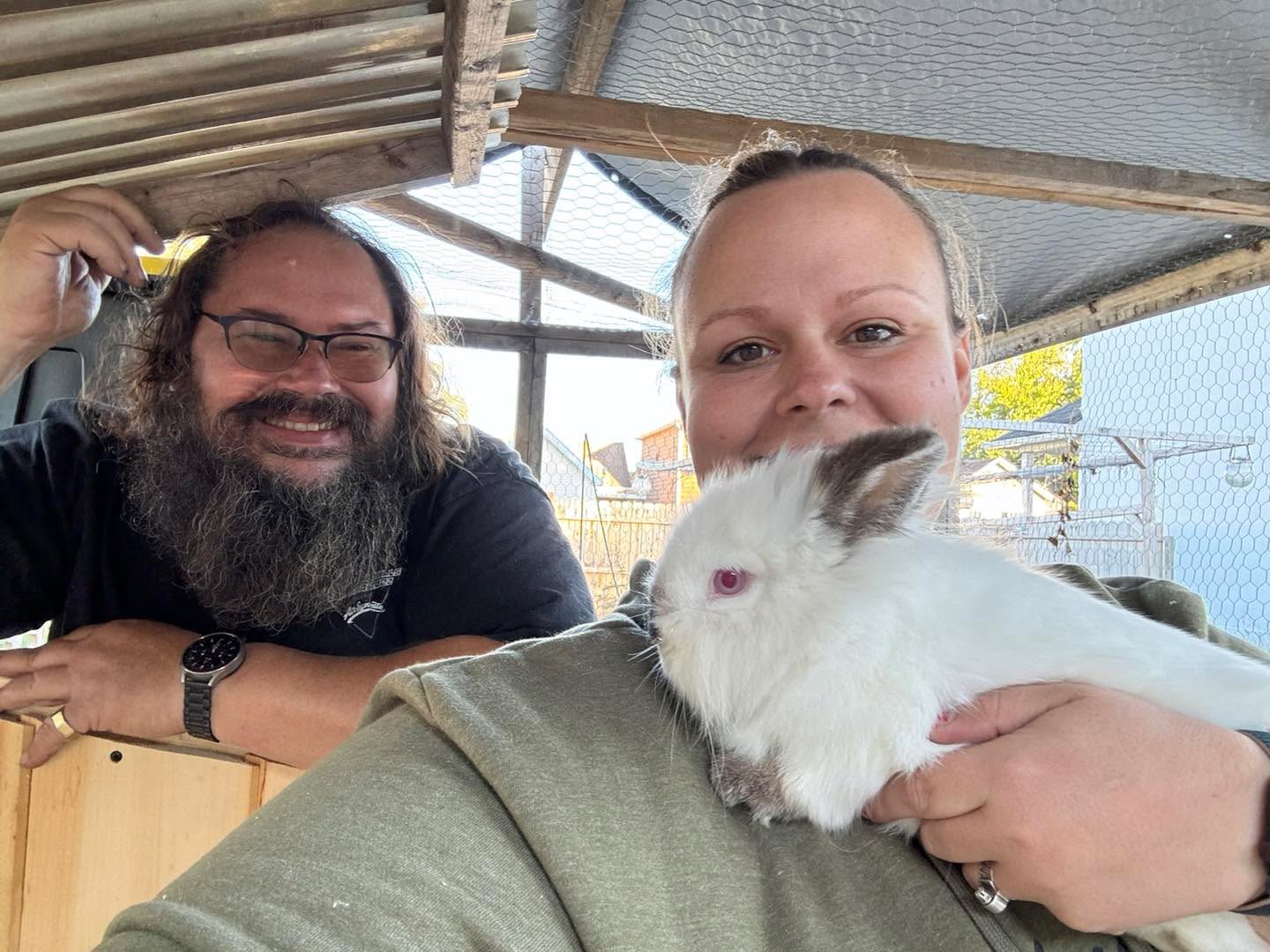
Alice is a Lionhead/Angora mix rabbit.
She is:
- ridiculously cute
- soft as a cloud
- quiet
- gentle
- easy to handle
In every way, she’s lovely.
So why on earth would I call her a bad bunny?
Because not every rabbit is meant to be a meat rabbit. And not every animal belongs in a production system.
Alice is tiny. Harvesting her for meat would be incredibly inefficient. As a fiber rabbit, she also falls short for our needs. It takes a lot of rabbit fiber to make usable yarn — and even more to offset feed costs. For a working homestead that uses a permaculture approach, she doesn’t produce enough yield. Therefore, breeding her for production is not justified.
Alice is not livestock here.
Alice is a pet.
She’s a rescue bunny, the last one left when another rabbit keeper stepped away from raising rabbits. She landed here because she needed a home — not because we needed production.
And that distinction matters.
Breed selection matters in permaculture livestock systems
In permaculture, we design with needs and yields in mind.
Every animal on a homestead should ideally:
- meet a need
- produce multiple yields
- fit within the system
- support soil health
- justify its inputs
If the needs of the animal far outweigh the yields it provides, then that animal has shifted from livestock to pet. And there’s nothing wrong with pets — but we must be honest about the role they play.
This is where many new homesteaders struggle. They fall in love with a cute animal first and ask production questions later.
When building a regenerative system, it has to be the other way around.
Why rabbit breed selection is critical

Rabbits can be one of the most efficient livestock choices for small-scale permaculture systems. They:
- reproduce quickly
- grow fast
- require little space
- produce high-quality manure
- convert feed into protein efficiently
But only if you start with the right breeds.
Choosing the wrong rabbit for meat production is like planting a peach tree when you really needed a shade tree. It might still be lovely — but it doesn’t serve the function you designed for.
A quick reality check
If your primary goal is manure only, almost any rabbit will do.
But if manure is the only meaningful output?
That animal is functioning as a pet with benefits — not true livestock.
In a permaculture system, we aim for stacked functions and multiple yields.
That’s where proper breed selection comes in.
Best rabbit breeds for meat production
If you’re raising rabbits for meat within a permaculture homestead, there are three breeds that consistently stand out.
New Zealand rabbits
The gold standard of meat rabbits.
- Rapid growth rate
- Kits reach 5–6 lbs in 10–12 weeks
- Excellent mothers
- Calm temperament
- Efficient feed conversion
They come in white, red, and black varieties and are widely used because they simply perform well.
Californian rabbits
Often considered the second pillar of meat rabbit production.
- Muscular, blocky body
- Fast growth
- Excellent carcass quality
- White coat with dark points (ears, nose, feet)
- Calm and manageable
Californians are a cross of Himalayan and Chinchilla ancestry and were designed specifically for meat production.
Silver Fox rabbits (our choice)
Our homestead chose the Silver Fox — and for good reason.
Silver Fox rabbits are a large, dual-purpose breed that align beautifully with permaculture principles.
They provide:
- substantial meat production
- beautiful, usable hides
- gentle temperament
- strong mothering instincts
- efficient feed conversion
But what really sold me?
Stacked yields.
Why we chose Silver Fox rabbits for our permaculture system
Permaculture teaches us to design systems where every element serves multiple functions.
With our Silver Fox rabbit colony, we receive:
- Meat for our family
- Nutrient-dense manure for the garden (cold manure — can go straight on beds)
- Hides for tanning and warm clothing
- Bones for broth
- Scraps for dog food
- Bone meal for soil health
Nothing wasted.
One of the core permaculture principles is:
Produce no waste.
A well-managed rabbit colony is one of the clearest examples of this principle in action.
Compare that to a small, low-yield rabbit that consumes feed but produces very little meat or fiber. Suddenly you can see why Alice — sweet as she is — simply doesn’t belong in the production plan.
The difference between pet rabbits and production rabbits
This is where many homesteaders feel guilty, so let’s say it plainly:
Not every animal needs to be productive.
But every production system needs clarity.
Alice is loved. She is safe. She is cared for.
She is not bred. She is not part of the meat program.
She is a pet — and that’s perfectly fine.
But when building a permaculture homestead, livestock must be chosen intentionally. Otherwise feed bills rise, space gets tight, and systems become inefficient quickly.
A “bad bunny” isn’t a bad animal.
It’s simply an animal that doesn’t match the system’s purpose.
Rabbit colony biosecurity: protecting your investment
Once you’ve chosen the right meat rabbit breeds — whether New Zealand, Californian, or Silver Fox — protecting that colony becomes critical.
Rabbit biosecurity is often overlooked, but disease can wipe out a colony quickly if precautions aren’t taken.
Core rabbit biosecurity practices
1. Closed colony whenever possible
Avoid constantly bringing in new rabbits. Each new animal introduces disease risk.
2. Quarantine new rabbits
Any new rabbit should be quarantined for at least 30 days before joining your colony.
3. Clean, dry housing
Rabbits are extremely sensitive to ammonia and dampness.
Good ventilation is non-negotiable.
4. Separate shoes and tools
Use dedicated footwear or boot dips for rabbit areas, especially if visiting other farms.
5. Rodent control
Wild rodents spread disease and contaminate feed.
6. Clean feeders and waterers regularly
Biofilm buildup spreads illness quickly in colonies.
7. Observe daily
Loss of appetite, lethargy, nasal discharge, or diarrhea should be addressed immediately.
8. Limit unnecessary visitors
Well-meaning friends who also keep rabbits can unintentionally carry pathogens.
In a permaculture system, biosecurity protects not just the rabbits — but your food supply, soil fertility, and overall homestead stability.
The permaculture lens: needs vs yields
Every time we add an animal to the homestead, we should ask:
- What does this animal need?
- What does it produce?
- Do the yields justify the inputs?
- Does it serve multiple functions?
- Does it support soil health?
Silver Fox rabbits check every box for us.
Alice does not.
And that’s okay.
Because permaculture isn’t about eliminating joy — it’s about designing systems that sustain life without burning us out.
Alice reminds us that not every creature has to be productive to be valuable.
But when it comes to building resilient food systems, breed selection matters.
So yes…
while Alice is sweet, soft, and deeply loved…
In terms of production and scale?
She’s absolutely a bad bunny.